


Final conference: Siena–Parma, 14–17 April 2026
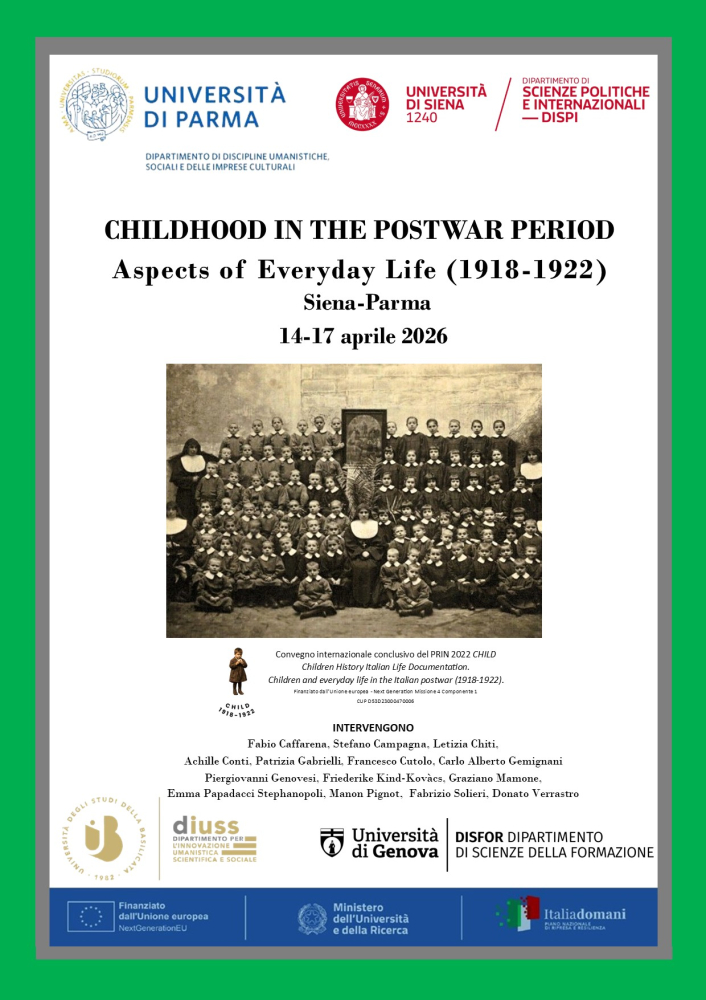
From 14 to 17 April, an international conference will be held to mark the conclusion of the PRIN CHILD project: Children, History, Italian Life, Documentation. Children and everyday life in post-war Italy (1918–1922), coordinated by Prof. Piergiovanni Genovesi, lecturer in contemporary history at our University.
The conference will begin in Siena, with sessions dedicated to gender issues and archives, and will conclude in Parma, where sessions on political and social issues and the presentation of the multimedia outputs produced will take place.
DOWNLOAD THE PROGRAMME FOR THE PARMA SESSION
The project investigated the condition of children in Italy in the immediate post-war period, with particular attention to situations of marginalisation and emergency: from orphans to refugees, the ‘abnormal’ and alcoholics.
The period under consideration was the four-year span from 1918 to 1922, suspended between the end of the Great War and the rise of fascism. In this context, the State began to pay increasingly marked attention to the child welfare system, which had, until then, remained on the margins of liberal political agendas.
Soon this sentiment would become firmly embedded within the framework of discourse marked by a strong nationalist, and indeed even more nationalistic, tone, and a system of interventions took shape aimed at assisting, protecting, caring for and educating the youngest children, but also at disciplining and guiding them. The case of school colonies is a prime example. Established in the late nineteenth century to accommodate frail or rickety children at risk of contracting tuberculosis, they expanded their functions and numbers during the war, transforming themselves increasingly from places of prophylaxis into spaces for moral training and education in ‘good manners’.
However, in the immediate post-war years, there were also different perspectives, giving rise to initiatives such as Save the Children, founded in 1919 in the United Kingdom, or the ‘Viennese children’ operation, which saw, between late 1919 and early 1920, thousands of ‘children of the former enemy’ were taken in by Italy to save them from the famine afflicting Vienna.
The project, funded by the European Union through the Next Generation Mission 4 programme, involved the University of Parma alongside those of Siena, Genoa and Basilicata.